
Diode
A fundamental semiconductor device that acts as a one-way valve for electrical current.
Component Preview
 Standard Diode
A diode allows current to flow easily in one direction (from Anode to Cathode) but severely restricts it in the opposite direction. It is commonly used for reverse-polarity protection, flyback protection on motors, and logic routing.
Overview
The silver band on a physical diode marks the Cathode (negative side). Current flows towards the band. In circuit diagrams, this is represented by the line at the point of the triangle.
Pin Reference
| Pin | Type | Description |
|---|---|---|
| A (Anode) | passive | The positive terminal. Current enters here. |
| C (Cathode) | passive | The negative terminal (marked with a band). Current exits here. |
Configurable Attributes
This component has no configurable attributes.
Working Principle
When the voltage at the Anode is higher than the Cathode (by at least the forward voltage drop, usually ~0.7V for silicon diodes), the diode is "forward-biased" and conducts electricity. If the voltage is reversed, the diode is "reverse-biased" and blocks the flow of electricity (acting like an open switch).
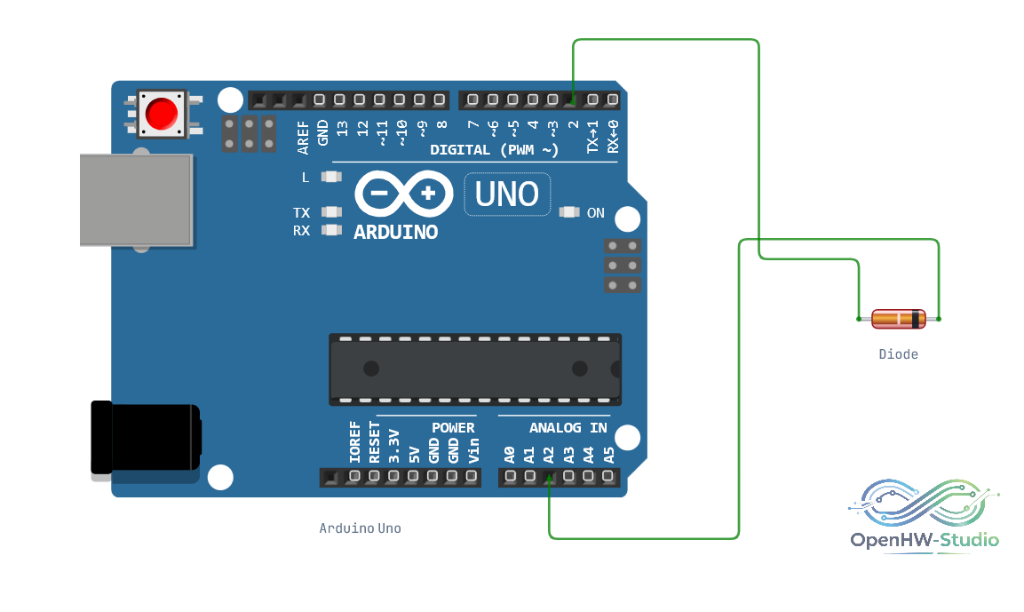
Wiring Diagram
Example of connecting the Diode to an Arduino Uno.
1. Reverse Polarity Protection
To protect a circuit from being wired backward, place the diode in series with the positive power line:
- Connect the Power Supply (+) to the diode Anode.
- Connect the diode Cathode to the VCC of your circuit.
2. Flyback Diode (Motor Protection)
When switching a motor or relay with a transistor, place a diode in parallel with the inductive load to safely dissipate the high-voltage spike created when the power is turned off:
- Connect the Cathode to the positive side of the motor.
- Connect the Anode to the negative side of the motor (the side connected to the transistor).