
ILI9341 2.8" TFT LCD
A fast, bright 320x240 full-color TFT display featuring an SPI interface.
Component Preview
 ILI9341 TFT
This module provides a beautiful 2.8" LCD with an ILI9341 driver. Because it uses the SPI bus, it requires very few pins to draw complex, full-color graphics.
DisplaysSPIColor
Overview
The ILI9341 is extremely fast and well-supported by libraries like Adafruit_GFX and TFT_eSPI. Note that this specific component model does not include a resistive touch overlay.
Pin Reference
| Pin | Type | Description |
|---|---|---|
| VCC | power | Power supply (3.3V or 5V depending on board regulator). |
| GND | power | Common ground. |
| CS | digital | TFT Chip Select. Active LOW. |
| RESET | digital | Hardware Reset. Connect to an Arduino pin or 3.3V. |
| DC | digital | Data/Command. Tells the screen if the incoming bytes are data or commands. |
| MOSI | digital | SPI Data In. |
| SCK | digital | SPI Clock. |
| LED | power | Backlight power. Usually connected to 3.3V. |
| MISO | digital | SPI Data Out. Needed to read from the display. |
Configurable Attributes
This component has no standard configurable attributes.
Working Principle
The display expects a continuous stream of RGB pixel data over the SPI bus.
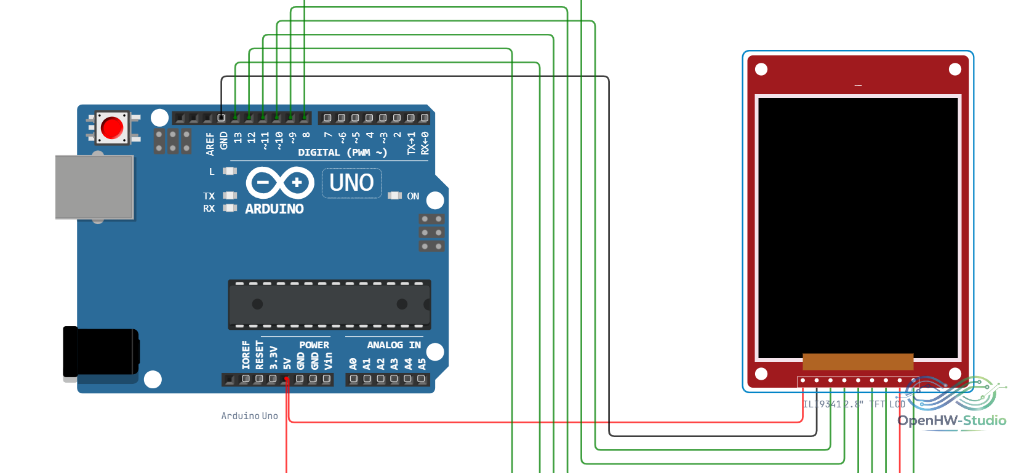
Wiring Diagram (Arduino Uno)
Example Arduino Code
This code requires the Adafruit_ILI9341 and Adafruit_GFX libraries.
cpp
#include <SPI.h>
#include <Adafruit_GFX.h>
#include <Adafruit_ILI9341.h>

#define TFT_CS 10
#define TFT_DC 9

Adafruit_ILI9341 tft = Adafruit_ILI9341(TFT_CS, TFT_DC);

void setup() {
  tft.begin();
  tft.setRotation(1);
  tft.fillScreen(ILI9341_BLACK);

  tft.setCursor(20, 100);
  tft.setTextColor(ILI9341_WHITE);
  tft.setTextSize(3);
  tft.println("OpenHW Studio");

  tft.setCursor(20, 140);
  tft.setTextSize(2);
  tft.println("TFT Ready");

  delay(2000);
  tft.fillScreen(ILI9341_BLACK);
}

void loop() {
  tft.setCursor(35, 140);
  tft.setTextSize(2);
  tft.setTextColor(ILI9341_WHITE, ILI9341_BLACK);
  tft.print("Time: ");
  tft.print(millis() / 1000);
  tft.print("s  ");
  delay(500);
}
Simulation Notes
- The simulator updates the display directly from the emulated SPI traffic.