
STM32 Blue Pill
A powerful 32-bit ARM Cortex-M3 microcontroller development board running at 72 MHz.
Component Preview
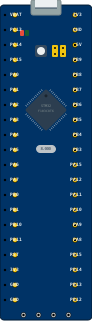 STM32 Board
The STM32 "Blue Pill" is a development board for the STM32F103C8T6 microcontroller. It offers significantly more processing power (72 MHz), memory (20KB SRAM, 64KB Flash), and peripherals than standard 8-bit Arduino boards while remaining highly affordable.
Overview
The Blue Pill can be programmed using the official STM32Cube ecosystem, or via the Arduino IDE using the STM32duino core. It features advanced timers, 12-bit ADCs, CAN bus, and multiple UART/I2C/SPI interfaces.
Pin Reference (Condensed)
Because the Blue Pill has over 30 pins, this table highlights the most commonly used power and programming pins.
| Pin | Type | Description |
|---|---|---|
| 3V3 | power | 3.3V Power Supply. |
| GND | power | Ground. |
| 5V | power | 5V input (passes through onboard regulator). |
| PC13 | digital | Built-in LED (Active Low). |
| SWDIO | digital | SWD Data (for programming/debugging). |
| SWCLK | digital | SWD Clock (for programming/debugging). |
| PA0-PA7 | analog | General Purpose I/O and 12-bit Analog Inputs. |
Configurable Attributes
This component has no configurable attributes.
Wiring Diagram
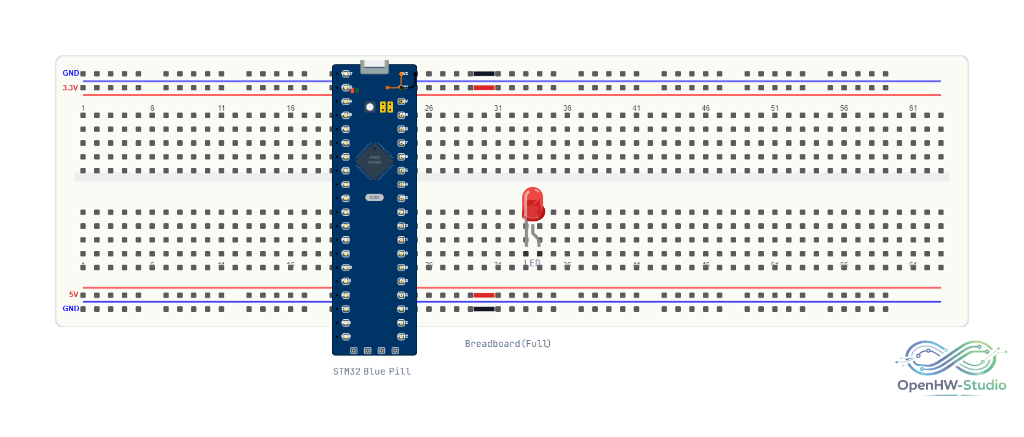
Example Arduino Code (STM32duino)
This standard blink sketch toggles the built-in LED on pin PC13. Note that on the Blue Pill, the LED is usually wired actively low (turns on when pin is LOW).
// Built-in LED on the Blue Pill is connected to PC13
const int ledPin = PC13;

void setup() {
  pinMode(ledPin, OUTPUT);
}

void loop() {
  digitalWrite(ledPin, LOW);  // Turn LED ON (Active Low)
  delay(1000);
  digitalWrite(ledPin, HIGH); // Turn LED OFF
  delay(1000);
}
Simulation Notes
- The OpenHW Simulator provides an emulation layer for the ARM Cortex-M3 core and core peripherals (GPIO, basic timers). Advanced hardware peripherals (like CAN or complex DMA chains) might not be fully simulated depending on the current engine version.